Aluminum Grating
Swage-locked and press-locked aluminum grating in 6061-T6 — about 1/3 the weight of steel with zero coating maintenance, mill or anodized finish, for marine, water treatment and weight-critical platforms.
Get a Quote Download CatalogSections & self-weight (swage-locked I-beam)
Screenshot-ready. Every dimension below is a standard tooling size — custom spacings are cut to your drawing at no extra mold cost.
| Bearing bar (mm) | Pitch (mm) | Weight (kg/m²) | U-load @1m (kN/m²) | Max span @ 3 kN/m² |
|---|---|---|---|---|
| 25×2 I-beam | 30 / 100 | 7.2 | 4.9 | 0.85 m |
| 32×2 I-beam | 30 / 100 | 8.6 | 7.4 | 1.05 m |
| 32×3 rectangular | 30 / 100 | 12.4 | 9.8 | 1.20 m |
| 38×3 I-beam | 30 / 100 | 11.7 | 12.6 | 1.35 m |
| 50×3 I-beam | 40 / 100 | 12.1 | 19.8 | 1.70 m |
Compare: a steel 32×3 / 30/100 panel weighs 26.5 kg/m²; the equivalent-duty aluminum panel 8.6–12.4 kg/m². Weight savings cascade into lighter support steel.
Choose your construction and material
Each family has its own load table, finish options and lead time.
Swage-Locked (I-beam)
Extruded I-beam bearing bars, swaged cross tubes — the standard walkway construction.
View series → Product FamilyPress-Locked Aluminum
Flat bars, flush architectural appearance — tight pitches for public areas.
View series → Product FamilyStainless Grating
The alternative corrosion-proof metal for chloride service.
View series → Product FamilyFRP Grating
Even lighter where loads are modest and chemicals are present.
View series →Four material systems, one factory
Zinc thickness is measured per ASTM A123 (70–85 µm), salt-spray tested to 1,000 h. Stainless is pickled and passivated; FRP resin is matched to your chemical media.
| Material | Specification | Best For | QC Note |
|---|---|---|---|
| Carbon Steel, Hot-Dip Galvanized | Q235B / A36, zinc 70–85 µm per ASTM A123 | Walkways, platforms, trench covers, stair treads — the default choice | 1,000 h neutral salt-spray test before white rust |
| Stainless Steel 304 / 316L | AISI 304 (indoor / general chemical), 316L (marine / chloride) | Food processing, pharma, offshore, chemical plants | Passivated and pickled finish, 316L for >3% chloride media |
| Aluminum 6061-T6 | Mill or anodized finish, riveted or press-locked construction | Weight-critical platforms, water treatment, architectural meshes | ≈ 1/3 the weight of steel at comparable spans — cannot be hot-dip galvanized |
| FRP / Fiberglass (GRP) | Molded (isophthalic / vinyl ester) or pultruded profiles | Electrolytic areas, sewage plants, coastal platforms | Non-conductive, non-sparking, corrosion-free alternative to metal |
Aluminum vs steel — same-duty comparison
Values calculated to NAAMM MBG 531 with deflection limited to L/200. Need a stamped calculation sheet for your span? Ask in the quote form.
| Metric @ 1.2 m span, 3 kN/m² | Steel 32×3 galv. | Aluminum 38×3 I-beam | FRP pultruded 40×40 |
|---|---|---|---|
| Self weight (kg/m²) | 26.5 | 11.7 | 13.8 |
| Corrosion protection | Zinc coating (consumable) | Inherent | Inherent |
| Weld repairable | Yes | No — bolted connections | No |
| Deflection @ duty | L/300 | L/200 | L/200 |
| Relative cost per m² | 1.0× | 2.2–2.8× | 1.8–2.5× |
Aluminum designs run at L/200 (elastic modulus 1/3 of steel) — sections are taller for the same span. The weight and maintenance savings, not the price, justify aluminum.
Where aluminum grating works hardest
Reference projects available per industry on request.
Docks, marinas, gangways
Salt-water-proof with zero coating upkeep — the classic aluminum duty.
Water treatment plants
Chloride-laden air destroys coatings; aluminum does not care.
Machine & enclosure floors
Weight budgets on skids and vehicles — 1/3 mass of steel.
Facades, ceilings, screens
Press-locked tight pitch, anodized architectural finishes.
Washdown areas
Non-rusting (pair with SS fasteners for hygiene service).
Access towers & stages
One-person handling — no crane for re-positioning.
Send a drawing, receive a finished panel
Upload DXF or DWG with your RFQ — we return a dimensioned shop drawing for approval within 24 hours. No approval, no production.
In-house fabrication
- Cut-to-size from DXF / DWG drawings — band saw and plasma, ±2 mm tolerance
- Notching and cutouts for pipes, cable trays and manholes in any shape
- Banding (closed ends) in flat bar or checkered plate, toe plates to EN ISO 14122-3
- Curved and radial panels for tanks, towers and architectural projects
- Stair tread fabrication with welded or bolted carriers, nosing options
- Pre-assembly of clips, anchors and support steel into kit form for site speed
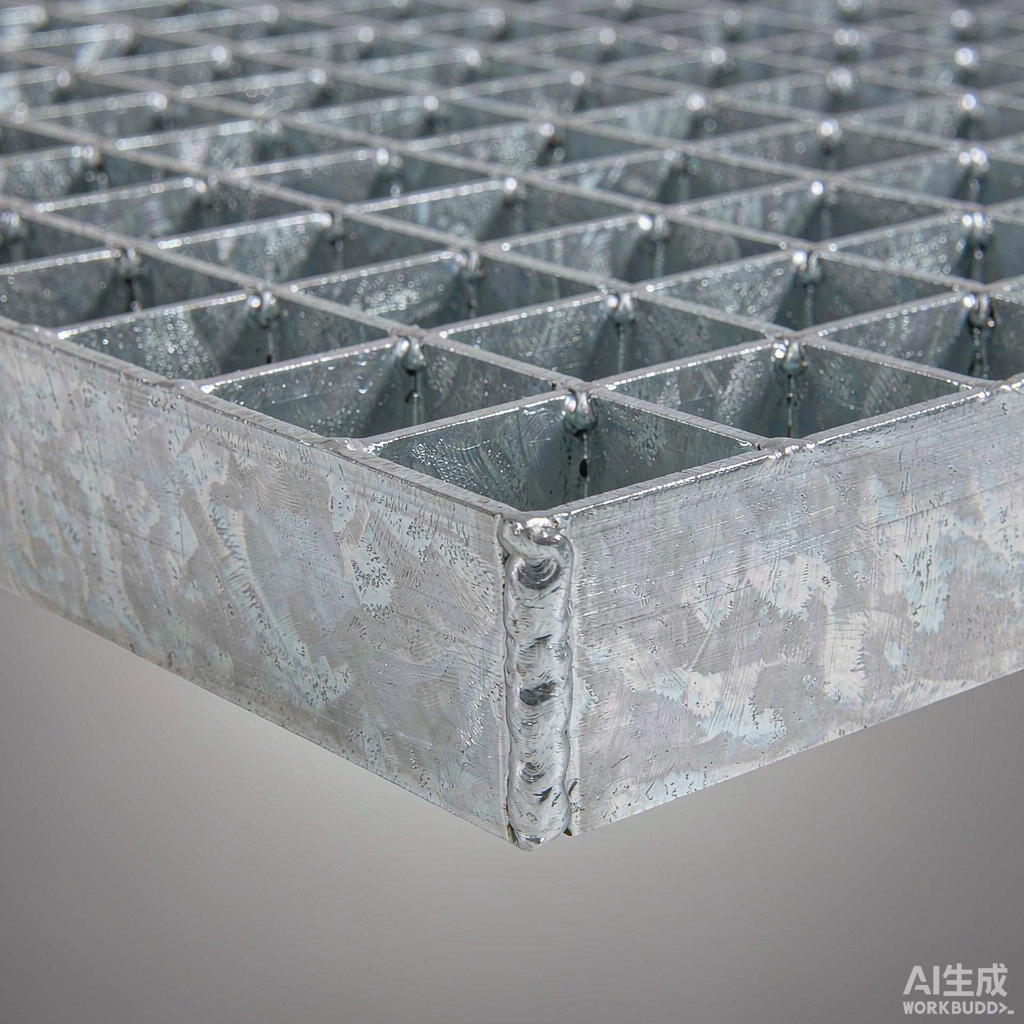
Everything is auditable
Third-party inspection (SGS/BV/TÜV) welcome at any stage. MTC per EN 10204 3.1 ships with every order by default.
✓
ASTM A36 — carbon structural steel bar and plate
✓
ASTM A123 — hot-dip galvanizing, 70–85 µm zinc coating on bearing bars
✓
ASTM A1011 / Q235B — flat bar feedstock with mill certificates
✓
NAAMM MBG 531 — load & deflection tables (uniform + concentrated load, L/200)
✓
EN 1090-1/-2 — structural steel execution, CE-marked assemblies
✓
ISO 9001:2015 — quality management system, audited annually
✓
MTC (EN 10204 3.1) material test certificate with every shipment
Ordering terms at a glance
1 pallet (approx. 20 m²) for stock sizes; custom sizes from 100 m²
15–25 days after drawing confirmation
20GP ≈ 26–28 t · 40HQ ≈ 26 t (varies with panel size)
FOB Shanghai / Ningbo · CIF & DDP available on request
T/T 30% deposit, L/C at sight for orders over USD 50,000
Aluminum grating is the weight-and-corrosion answer: 6061-T6 structural alloy at roughly 1/3 the weight of steel, forming its own oxide barrier so there is no coating ever to maintain. This page gives engineers the comparison table that decides between steel, aluminum and FRP — including the limitations the catalogs tend to omit.
The honest limitations of aluminum grating
Publishing these is why engineers keep this page bookmarked:
- It cannot be hot-dip galvanized — irrelevant (it does not need it) but occasionally specified in error by US standards habit.
- Welded construction is weak — heat-affected 6061-T6 drops to T4 strength at welds, so aluminum grating is swage-locked or press-locked, never welded. Field repairs are bolted.
- Lower stiffness — Young’s modulus is 1/3 of steel, so deflection governs: for the same span an aluminum section is one size taller than steel.
- Galvanic pairing — never bolt bare aluminum to bare steel or stainless in wet service; isolate with neoprene pads and isolation washers (we supply them with the clips).
- No serration — soft teeth deform; anti-slip comes from a fine pitch or grit inserts, or switch to FRP grit top.
Same-duty weight and cost study
The load table above compares three systems at an identical duty (1.2 m span, 3 kN/m² pedestrian-plus-maintenance). Steel wins on price; aluminum wins on lifecycle (no re-coating, no corrosion inspection) and on any structure where the grating dead load drives the support-steel size — on long elevated aluminum walkways the support-steel saving frequently pays the grating premium.
Finishes & fabrication
Mill finish suits industrial service. Anodizing (15–25 µm) is specified for architectural visibility — it stabilizes appearance and eases cleaning but adds no meaningful corrosion benefit. Cutting, notching and banding use the same CNC paths as steel; banding is riveted or bolted, never welded.
Frequently asked questions
Why can’t aluminum grating be welded?
Does aluminum grating rust?
Is it as strong as steel?
Can I put aluminum grating on steel supports?
What finish do I need outdoors?
Aluminum or FRP for a marina walkway?
Get a quote within 24 hours
Include panel size, load requirement and quantity — or just upload your drawing. Our engineers respond with a price and a load check.
Attach your file, then send the form — your email client will open with the details pre-filled. For files over 10 MB, email sales@yhsteelgrating.com directly.
✓ Your email client has opened with the RFQ details. Didn't open? Write to sales@yhsteelgrating.com.