Serrated Steel Grating
Anti-slip steel grating with cold-serrated notches on the bearing bar tops — grip that survives oil, rain and ice, in hot-dip galvanized carbon steel or 304/316L stainless.
Get a Quote Download CatalogSerrated sections & honest capacity comparison
Screenshot-ready. Every dimension below is a standard tooling size — custom spacings are cut to your drawing at no extra mold cost.
| Bearing bar (mm) | Pitch (mm) | Plain U-load @1m (kN/m²) | Serrated U-load @1m (kN/m²) | Serrated weight |
|---|---|---|---|---|
| 25×3 | 30/100 | 6.6 | 5.9 (−11%) | 22.9 kg/m² |
| 32×3 | 30/100 | 11.0 | 9.7 (−12%) | 27.1 kg/m² |
| 32×5 | 30/100 | 18.3 | 16.1 (−12%) | 43.7 kg/m² |
| 40×5 | 40/100 | 28.7 | 24.9 (−13%) | 40.6 kg/m² |
| 50×5 | 50/100 | 44.9 | 38.2 (−15%) | 35.6 kg/m² |
Most catalogs hide this table: serration removes top-edge metal, so identical sections carry 10–15% less. The fix costs nothing — step up one bar size and you are back above plain capacity.
Choose your construction and material
Each family has its own load table, finish options and lead time.
Serrated Walkway Panels
Standard 30/100 and 40/100 pitches, galvanized.
View series → Product FamilySerrated Stair Treads
The classic application — see the R-value data.
View series → Product FamilyDeep-Tooth Serrated
Coarse serration for ice, mining and oil platforms.
View series → Product FamilySerrated Stainless
316L serrated for food and marine stairs.
View series →Four material systems, one factory
Zinc thickness is measured per ASTM A123 (70–85 µm), salt-spray tested to 1,000 h. Stainless is pickled and passivated; FRP resin is matched to your chemical media.
| Material | Specification | Best For | QC Note |
|---|---|---|---|
| Carbon Steel, Hot-Dip Galvanized | Q235B / A36, zinc 70–85 µm per ASTM A123 | Walkways, platforms, trench covers, stair treads — the default choice | 1,000 h neutral salt-spray test before white rust |
| Stainless Steel 304 / 316L | AISI 304 (indoor / general chemical), 316L (marine / chloride) | Food processing, pharma, offshore, chemical plants | Passivated and pickled finish, 316L for >3% chloride media |
| Aluminum 6061-T6 | Mill or anodized finish, riveted or press-locked construction | Weight-critical platforms, water treatment, architectural meshes | ≈ 1/3 the weight of steel at comparable spans — cannot be hot-dip galvanized |
| FRP / Fiberglass (GRP) | Molded (isophthalic / vinyl ester) or pultruded profiles | Electrolytic areas, sewage plants, coastal platforms | Non-conductive, non-sparking, corrosion-free alternative to metal |
Slip performance: serrated vs plain (DIN 51130 oily ramp)
Values calculated to NAAMM MBG 531 with deflection limited to L/200. Need a stamped calculation sheet for your span? Ask in the quote form.
| Surface | Ramp angle achieved | Slip class | Wet performance |
|---|---|---|---|
| Plain bar, galvanized | ≈ 10° | R9 | Poor when wet/oily |
| Serrated bar, standard tooth | ≈ 24° | R12 | Good |
| Serrated bar, deep tooth | ≈ 28°+ | R13 | Excellent — ice, mud |
| Checkered plate (for reference) | ≈ 12° | R10 | Treacherous with oil film |
R-classes per DIN 51130 (oiled surface test): R9 ≤10°, R10 ≤14°, R11 ≤18°, R12 ≤24°, R13 ≥27°. OSHA’s slip-resistant requirement in wet locations is satisfied from R11 up.
Where serrated steel grating works hardest
Reference projects available per industry on request.
Outdoor stairs & fire escapes
Rain, snow and ice — the standard serrated application.
Machine shops & press floors
Coolant films make plain bars and checker plate unusable.
Food processing stairs
316L serrated where hygiene rules allow serrations.
Docks, gangways, offshore
Deep-tooth serration with salt-spray-rated coating.
Mines & processing plants
Mud and slurry — deep tooth profile.
Cooling towers & wet decks
Constantly wet service around treatment plants.
Send a drawing, receive a finished panel
Upload DXF or DWG with your RFQ — we return a dimensioned shop drawing for approval within 24 hours. No approval, no production.
In-house fabrication
- Cut-to-size from DXF / DWG drawings — band saw and plasma, ±2 mm tolerance
- Notching and cutouts for pipes, cable trays and manholes in any shape
- Banding (closed ends) in flat bar or checkered plate, toe plates to EN ISO 14122-3
- Curved and radial panels for tanks, towers and architectural projects
- Stair tread fabrication with welded or bolted carriers, nosing options
- Pre-assembly of clips, anchors and support steel into kit form for site speed
Everything is auditable
Third-party inspection (SGS/BV/TÜV) welcome at any stage. MTC per EN 10204 3.1 ships with every order by default.
✓
ASTM A36 — carbon structural steel bar and plate
✓
ASTM A123 — hot-dip galvanizing, 70–85 µm zinc coating on bearing bars
✓
ASTM A1011 / Q235B — flat bar feedstock with mill certificates
✓
NAAMM MBG 531 — load & deflection tables (uniform + concentrated load, L/200)
✓
EN 1090-1/-2 — structural steel execution, CE-marked assemblies
✓
ISO 9001:2015 — quality management system, audited annually
✓
MTC (EN 10204 3.1) material test certificate with every shipment
Ordering terms at a glance
1 pallet (approx. 20 m²) for stock sizes; custom sizes from 100 m²
15–25 days after drawing confirmation
20GP ≈ 26–28 t · 40HQ ≈ 26 t (varies with panel size)
FOB Shanghai / Ningbo · CIF & DDP available on request
T/T 30% deposit, L/C at sight for orders over USD 50,000
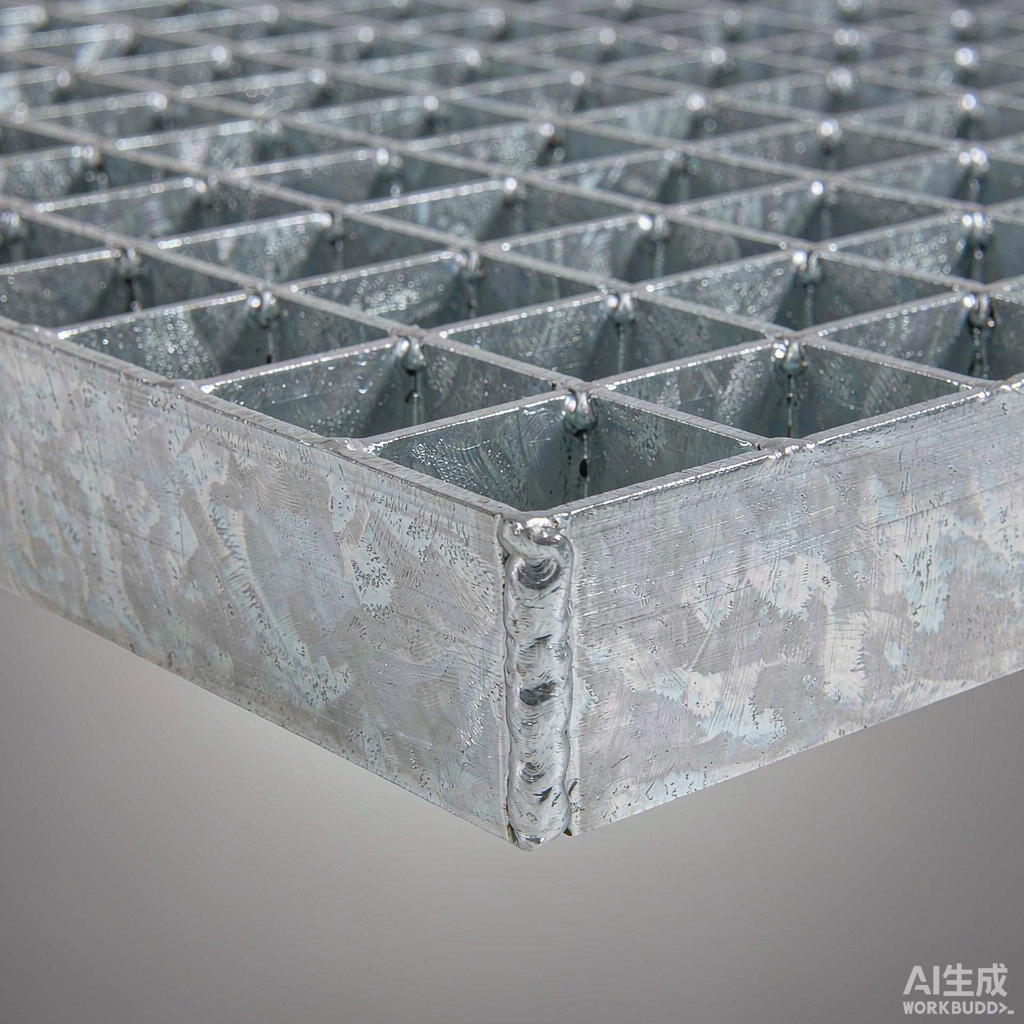
Serrated steel grating is the same welded product as plain grating with one difference that matters: the top edge of every bearing bar carries a row of cold-pressed notches. Those teeth bite through water, oil films and ice — the difference between R9 (a plain bar) and R12–R13 slip ratings.
This page is deliberately honest about the trade: serration costs 10–15% load capacity in the same bar section. We publish the comparison table because most distributors do not — and because our answer to it (step up one bar size) is free advice that our competitors charge engineering hours for.
Serration vs plain: the full trade
The notch pattern removes roughly 8–12% of the top-edge section of each bearing bar, reducing section modulus by 10–15% — hence the capacity numbers in the table above. Deflection at a given load increases by the same proportion. In practice: a 32×3 plain walkway becomes a 32×5 serrated walkway (heavier but stronger than the original plain), or you accept 12% less margin — almost never the right call on a stair.
When is plain correct? Clean dry interiors, food areas where serrations trap soil, and budget-driven dry service. Everywhere wet, oily or icy — serrated, or deep-tooth serrated if mud and slurry are involved.
Deep-tooth: the step beyond standard serration
Standard serration is pressed with a fine tooth ~1.5 mm deep. Our deep-tooth variant presses a coarser 3 mm notch with wider spacing — cleaning mud and slurry out of the teeth and keeping grip under ice glaze. It tests at R13 and is the profile we supply to mining and offshore customers. Same capacity penalty family, same tooling.
Specifying serrated correctly
Four decisions: material (galvanized carbon steel default; 316L for coastal/food), pitch (30/100 walkway standard), bar size (one step above your plain-bar load calc), and surface (standard vs deep tooth). Then the same NAAMM MBG 531 check applies — we run it against the serrated section, not the plain, so your approval sheet is honest.
Frequently asked questions
Does serrated grating hold less load than plain?
What slip rating does serrated grating achieve?
When should I NOT use serrated?
Can serrated grating be galvanized?
Is serrated available in stainless and aluminum?
Do the teeth wear down?
Get a quote within 24 hours
Include panel size, load requirement and quantity — or just upload your drawing. Our engineers respond with a price and a load check.
Attach your file, then send the form — your email client will open with the details pre-filled. For files over 10 MB, email sales@yhsteelgrating.com directly.
✓ Your email client has opened with the RFQ details. Didn't open? Write to sales@yhsteelgrating.com.